Everest Base Camp Helicopter Tour: A One-Day Flight to Kala Patthar (Kalapatthar)
6
Hours
Not everyone has two weeks of vacation leave and the physical conditioning required to hike 130 kilometers round-trip to Everest Base Camp—and for decades, that meant most travelers never got to stand face-to-face with the world's highest peak at all.
The Everest Base Camp Helicopter Tour changes that equation in a single morning.
Lifting off from Kathmandu aboard a high-altitude Airbus H125 (Eurocopter AS350 B3e) helicopter, you cover terrain that takes trekkers ten days on foot—soaring above the Dudh Koshi River valley, flying directly over Everest Base Camp (5,364m) and the Khumbu Icefall, and touching down at Kala Patthar (Kalapatthar, 5,545m / 18,192ft) before morning clouds touch the summit of Mount Everest (8,848.86m) and Lhotse (8,516m).
This isn't a distant flyover from a commercial airplane cabin window. You step out onto the roof of the Khumbu at 5,545 meters with Mount Everest rising directly in front of you, descend to Hotel Everest View (3,880m) in Syangboche for a hot Himalayan breakfast overlooking Ama Dablam, and return to your Kathmandu hotel before midday.
Whether you join a Shared Group Flight (from $1,350 per person) or charter a Private Helicopter (from $4,500 per charter / $1,500–$1,680 per person for small private groups), every departure includes private hotel transfers, supplemental oxygen support, and veteran Himalayan mountain pilots.
Key Highlights of the Everest Base Camp Helicopter Tour
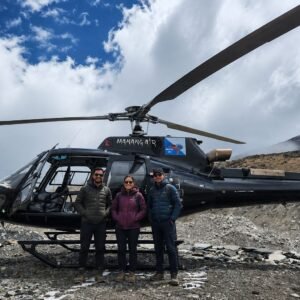
Land at Kala Patthar (5,545m / 18,192ft): Touch down for 10–15 minutes at the single highest and clearest ground viewpoint for Mount Everest's south face, Nuptse, Pumori, and Lhotse—without walking a single day on the trail.
Low-Altitude Flyover of Everest Base Camp (5,364m) & Khumbu Glacier: Glide directly above the expedition tents of Everest Base Camp, the serrated ice towers of the Khumbu Icefall, and the turquoise meltwater ponds of the Khumbu Glacier.
Breakfast at the Iconic Hotel Everest View (3,880m): Enjoy a 30-to-45-minute sit-down breakfast on the panoramic terrace of Syangboche's Guinness World Record high-altitude hotel, framed by Ama Dablam (6,812m) and Everest.
Guaranteed Window Perspective in an Airbus H125 (B3e) Helicopter: Fly in Nepal's premier high-altitude mountain rescue and sightseeing aircraft, capped at a maximum of 5 passengers with panoramic forward and side glass.
Flexible Shared Group Seats & Private Charter Options: Join a scheduled small-group departure as a solo traveler or couple, or book a dedicated Basic, Standard, or Luxury private charter tailored to your schedule.
Door-to-Door in 4.5 to 5.5 Hours with Full Oxygen Backup: Depart your Kathmandu hotel at 5:30 AM and return by 11:30 AM, backed by onboard emergency oxygen cylinders, CAAN weather clearance protocols, and a 100% weather-cancellation refund guarantee.
[wte_itinerary_downloader]
'[Trip_Info_Shortcode id=738]
A One-Day Encounter with Mount Everest
Imagine lifting off from the Kathmandu Valley at dawn as the eastern Himalaya catches the first gold light of morning. Within forty-five minutes, terraced hillsides give way to the dramatic rock gorge of the Dudh Koshi River and the short sloped runway of Tenzing-Hillary Airport in Lukla (2,860m).
After a brief 10-to-15-minute fuel check, your Mount Everest Helicopter Tour climbs past the Sherpa capital of Namche Bazaar, the hilltop monastery of Tengboche, and the sheer granite spire of Ama Dablam.
Above 5,000 meters, the scale of the Mahalangur Himalaya becomes breathtakingly immediate. Your pilot arcs over Gorak Shep (Gorakhshep, 5,164m) and Everest Base Camp (5,364m), giving you an unobstructed aerial look into the labyrinth of the Khumbu Icefall before setting the helicopter skids down on the rocky ridge of Kala Patthar (5,545m).
Because Everest Base Camp sits directly beneath the shoulder of Nuptse, Everest's true summit is hidden from Base Camp itself—making Kala Patthar the undisputed best vantage point in the Khumbu region.
After soaking in the 360-degree panorama at 5,545 meters, you drop down to the oxygen-rich air of Syangboche (3,880m) for hot coffee, eggs, and freshly baked pastries at the legendary Hotel Everest View before flying back to Kathmandu in time for lunch.
Why Choose This Everest Base Camp Helicopter Tour? (Comparing Your Everest Options)
At Himalayan Walkers, we operate five distinct ways to experience Mount Everest, and choosing the right itinerary comes down to your available days in Nepal, your budget, and whether you want to hike on foot or fly both ways.
Choose this 1-Day Everest Base Camp Helicopter Tour if you want to actually land at 5,545 meters and eat breakfast at Hotel Everest View in a single morning with zero trekking.
Choose our10-Day Everest Base Camp Trek with Helicopter Return if you want the full physical achievement of walking up the trail to Base Camp and Kala Patthar over 8 trekking days (with full acclimatization in Namche and Dingboche), then flying back from Gorak Shep by helicopter to skip the 3-day knee-pounding walk down.
Choose our4-Day Kathmandu Sightseeing with Everest Helicopter Tour if you want this exact 1-day helicopter landing tour bundled with 3 nights of Kathmandu hotel accommodation, airport transfers, and a full-day guided tour of 4 UNESCO World Heritage Sites.
Choose our1-Hour Everest Mountain Flight if you want a budget-friendly ($280) fixed-wing airplane window-seat flyby over the Everest range without a high-altitude landing.
Feature
1-Day EBC Helicopter Tour (This Trip)
4-Day Kathmandu + Everest Heli Tour
10-Day EBC Trek with Heli Return
14-Day Classic EBC Trek
1-Hour Everest Mountain Flight
Total Duration
4.5 to 5.5 Hours
4 Days / 3 Nights
10 Days / 9 Nights
14 Days / 13 Nights
4 Hours (1-Hr Flight)
Trekking Required
None (100% Helicopter)
None (City Tour + Heli)
Trek up (~65 km); Fly down
Full trek both ways (130 km)
None (Fixed-Wing Plane)
Kala Patthar Landing
Yes (5,545m / 18,192ft)
Yes (5,545m / 18,192ft)
Hiked on foot (Day 10)
Hiked on foot
No (Aerial Flyby Only)
Everest View Breakfast
Included (3,880m)
Included (3,880m)
Acclimatization hike stop
Acclimatization hike stop
Not applicable
Physical Effort
Easy (Ages 5–80)
Easy (Ages 10–75)
Moderate to Strenuous
Strenuous
Easy (All Ages)
Starting Price (USD)
$1,450 Shared / $1,680 Pvt (3-Pax)
From $1,950 / person
From $3,200 / person
From $1,180 / person
$280 / person
Helicopter Fleet, High-Altitude Physics & The Pheriche (4,240m) Shuttle System
Operating commercial passenger flights above 5,000 meters requires world-class aircraft and strict adherence to Civil Aviation Authority of Nepal (CAAN) weight-and-balance regulations. Understanding how high-altitude mountain aviation works before you book ensures a smooth, surprise-free morning.
1. Aircraft Specification: Airbus H125 (Eurocopter AS350 B3e)
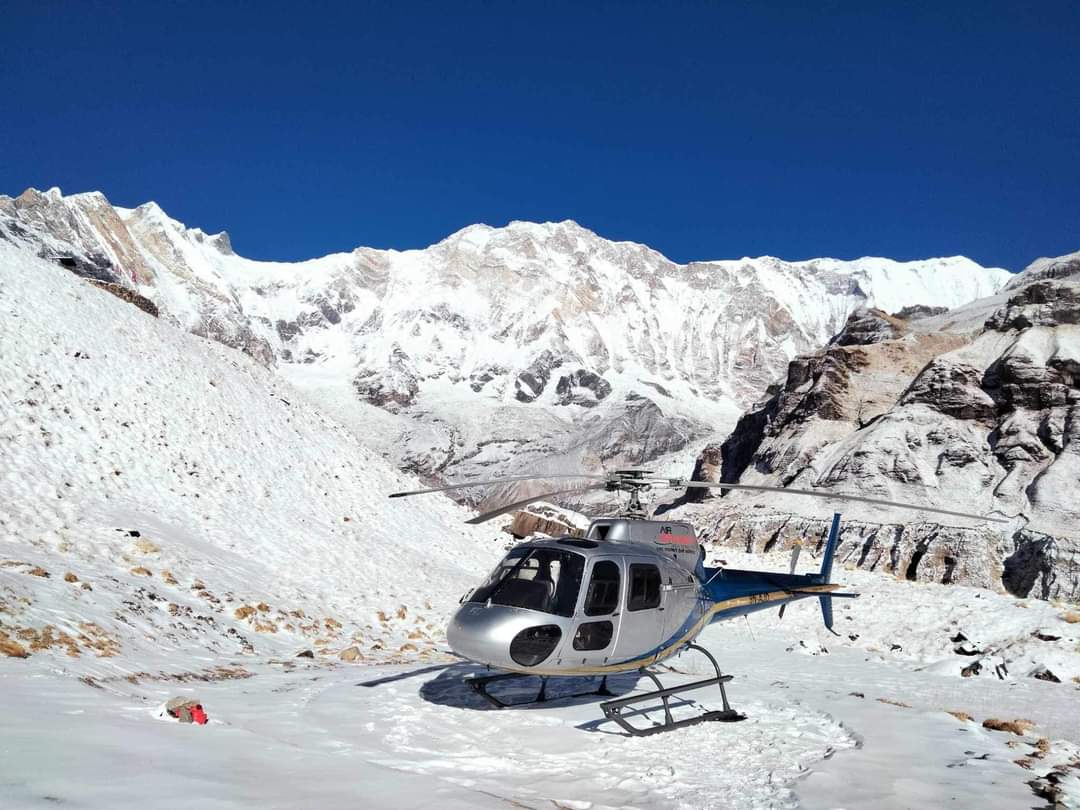
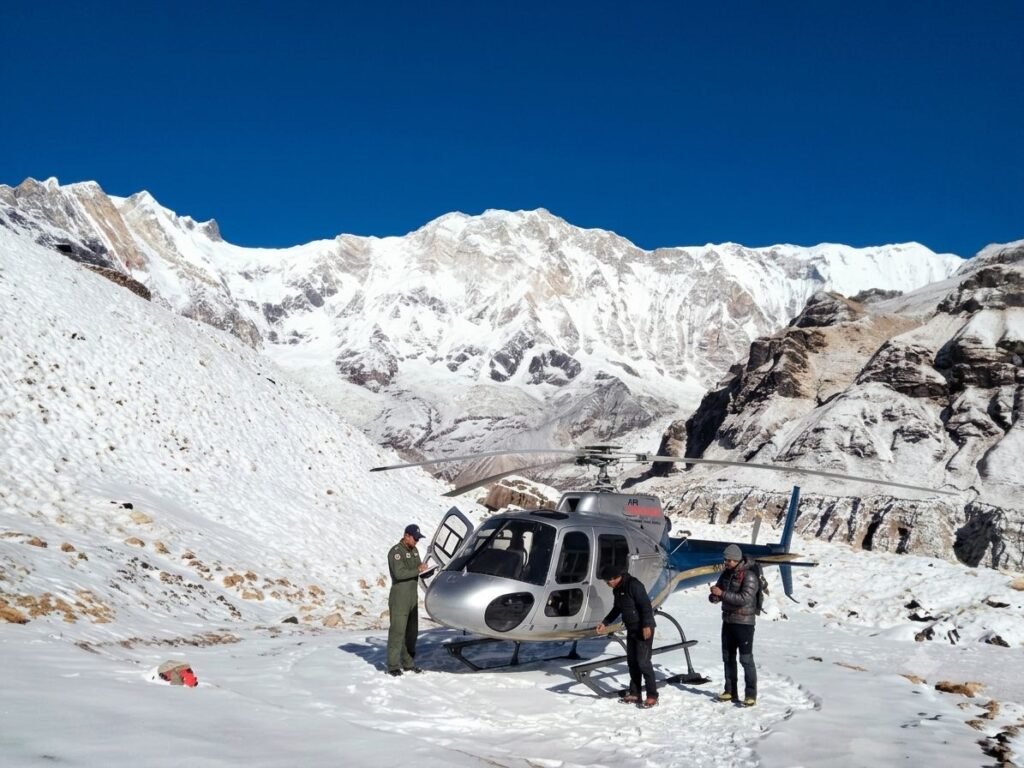
All of our Everest helicopter departures utilize the Airbus H125 (formerly Eurocopter AS350 B3e "Squirrel"), powered by a Safran Arriel 2D turboshaft engine.
Renowned globally as the undisputed workhorse of high-altitude Himalayan aviation—and holder of the world record for landing on the summit of Mount Everest—the H125 features a certified service ceiling of 23,000 feet (7,010 meters), large distortion-free viewing windows, and a 5-passenger cabin layout.
Aircraft Parameter
Airbus H125 (AS350 B3e) Specification
Operational Impact on Your Tour
Manufacturer & Engine
Airbus Helicopters (France) / Safran Arriel 2D
High power-to-weight ratio engineered for thin Himalayan air.
Maximum Cabin Capacity
5 Passengers + 1 Captain
Every guest enjoys unobstructed forward or side mountain views.
Payload Limit: Kathmandu to Lukla (2,860m)
Up to 500 kg (1,102 lbs) total payload
All 5 passengers fly together in one helicopter from Kathmandu to Lukla and Pheriche.
Payload Limit: Above 4,200m (Kala Patthar 5,545m)
Maximum 220 – 250 kg (485 – 550 lbs)
Groups of 4–5 passengers split into two quick 15-minute shuttles at Pheriche (4,240m).
Maximum Operating Altitude
23,000 ft (7,010 m)
Provides a generous safety margin above Kala Patthar (18,192 ft / 5,545 m).
Onboard Oxygen System
Supplemental oxygen cylinders & nasal masks
Available at every seat during the high-altitude leg above 4,500 meters.
2. Why Helicopters Land at Kala Patthar (5,545m) Instead of the EBC Tent City
Travelers frequently ask whether the helicopter lands directly on the ice at Everest Base Camp (5,364m). Commercial sightseeing helicopters do not land on the Base Camp glacier for three reasons:
Superior Summit Visibility: Everest Base Camp sits in a glacial bowl directly beneath the West Shoulder of Everest and Nuptse, which blocks the view of Everest's actual peak. Kala Patthar (5,545m) sits 181 meters higher on the opposite ridge, offering a direct, unobstructed view of Everest's entire south face from base to summit.
Active Glacial Ice Safety: Base Camp rests on the shifting moraine and crevasses of the moving Khumbu Glacier, whereas Kala Patthar and Gorak Shep (5,164m) provide solid, permanent rock helipads.
Sagarmatha National Park Conservation Rules: To protect mountaineering expeditions and fragile glacial ecosystems, landings at the EBC rock are restricted to emergency medical evacuations. Instead, your pilot performs a low, slow scenic pass directly over Everest Base Camp and the Khumbu Icefall before touching down at Kala Patthar.
3. How the Pheriche (4,240m) Weight-Shuttle Works for Groups of 4 to 5
At 5,545 meters, atmospheric air density is roughly half that of sea level, which reduces rotor lift capacity. Under mandatory CAAN aviation safety rules, a helicopter cannot land and take off at Kala Patthar with more than 250 kg (roughly 2 to 3 adult passengers) on board:
If your private group has 1 to 3 passengers (under 250 kg total): You fly non-stop from Lukla over Everest Base Camp, land at Kala Patthar in a single flight with zero shuttle split, and proceed directly to Hotel Everest View.
If your group (or shared flight) has 4 to 5 passengers: The helicopter lands briefly at the scenic valley helipad in Pheriche (4,240m). The first 2–3 passengers fly the 15-minute loop over Everest Base Camp and land at Kala Patthar while the remaining 2 passengers enjoy mountain views in Pheriche.
The helicopter then returns to Pheriche to fly the second sub-group to Kala Patthar before reuniting all 5 passengers at Hotel Everest View (3,880m) for breakfast together. Both sub-groups get the exact same ground time at Kala Patthar and guaranteed window views on the high-altitude loop.
Best Season & Monthly Weather Guide for the Everest Base Camp Helicopter Tour
While the Everest Base Camp Helicopter Tour operates year-round whenever morning skies are clear, visibility and wind conditions in the Khumbu region vary by season. Because afternoon thermal winds build up in the Dudh Koshi valley after 11:00 AM, all departures lift off between 6:00 AM and 7:00 AM when mountain air is calmest and skies are sharpest.
Season & Months
Visibility & Flying Reliability
Kala Patthar Temp (Morning)
Why Fly in This Window?
Autumn Peak (September – November)
95%+ Clear Mornings (Best Overall)
-5°C to -12°C (23°F to 10°F)
Post-monsoon rain washes dust from the atmosphere, delivering razor-sharp cobalt skies and the highest flight dispatch reliability of the year.
Spring Peak (March – May)
90%+ Clear Mornings (Warmest & Most Vibrant)
-2°C to -8°C (28°F to 17°F)
Milder high-altitude temperatures, blooming crimson rhododendron forests in the lower hills, and colorful expedition tent cities visible at Everest Base Camp.
Winter Clear Skies (December – February)
80% Clear Mornings (Quiet & Snow-Draped)
-12°C to -20°C (10°F to -4°F)
Crystal-clear morning visibility above valley mist and dramatic snow-blanketed peaks with almost no air traffic congestion—just dress in heavy down layers.
Summer Monsoon (June – August)
35–50% Weather Windows (Buffer Days Required)
0°C to 5°C (32°F to 41°F)
Warm temperatures and lush green terraces, but frequent cloud cover requires flexible scheduling and 2–3 buffer mornings in Kathmandu.
What to Pack & Wear for Your Morning Flight
Even though you return to warm Kathmandu weather by midday, you will spend 10–15 minutes standing outside at 5,545 meters and 45 minutes at 3,880 meters. Dress in easy-to-remove layers:
Insulated Windproof Down Jacket: Essential for the 15-minute stop at Kala Patthar (complimentary loaner down jackets are available from our Kathmandu office upon request).
UV-400 Polarized Sunglasses & SPF 50+ Sunscreen: Snow glare above 5,000 meters is intense even on a short morning stop.
Warm Beanie, Neck Buff & Windproof Gloves: Rotor wash and sub-zero mountain breeze chill bare hands quickly while taking photos.
Closed-Toe Walking or Trail Shoes: The helipads at Kala Patthar and Syangboche are uneven stone and gravel.
Original Passport (Plus Digital Copy): Required for domestic terminal check-in at Tribhuvan International Airport and Sagarmatha National Park permit verification.
Camera, Smartphone & Fully Charged Battery: Cold air drains lithium-ion batteries rapidly; keep your phone in an inside jacket pocket until landing.
From hotel pickup to hotel drop-off, this Everest Base Camp Helicopter Tour follows a tightly coordinated 5-to-5.5-hour morning schedule. Every departure is cleared with Tribhuvan Domestic Tower and Lukla Mountain Dispatch at dawn to maximize your ground time in clear morning light.
How The Day Unfolds
5:30 AM – 6:15 AM: Private Hotel Pickup & Transfer to Kathmandu Domestic Airport (1,350m / 4,429ft)
A Himalayan Walkers representative and private vehicle collect you directly from your hotel in Kathmandu (Thamel, Lazimpat, Boudha, or Patan) for the 15-to-25-minute drive to the Helicopter Terminal at Tribhuvan International Airport (TIA). Remember to bring your original passport, warm down layer, sunglasses, and camera.
6:15 AM – 6:40 AM: Helipad Check-In, Passenger Weight Balance & Pilot Safety Briefing
Our airport coordinator escorts you through domestic security and check-in. Aviation staff record each passenger's body weight and daypack weight—a mandatory CAAN safety procedure used to calculate exact fuel loads and high-altitude shuttle balance. Before boarding the Airbus H125 (B3e) helicopter, your captain conducts a pre-flight safety briefing covering rotor clearance, headset intercom communication, and onboard oxygen masks.
6:40 AM – 7:25 AM: Scenic Helicopter Flight from Kathmandu to Lukla (2,860m / 9,383ft)
Flight Duration: ~45 Minutes Lifting off from Kathmandu, the helicopter climbs eastward over the medieval brick rooftops of Bhaktapur, the ridge of Nagarkot, and the terraced valleys of Dolakha and Jiri.
Within 20 minutes, the snow-clad peaks of Langtang Lirung, Gaurishankar (7,134m), and Numbur rise to the north before your pilot banks into the Dudh Koshi gorge and touches down at Tenzing-Hillary Airport in Lukla (2,860m)—famous as the world's most dramatic mountain airstrip.
7:25 AM – 7:40 AM: Ground Refueling Stop at Tenzing-Hillary Airport, Lukla (2,860m / 9,383ft)
Ground Time: 10–15 Minutes While the ground crew refuels the aircraft and performs high-altitude flight checks, you can step onto the Lukla tarmac to stretch your legs, breathe the crisp pine-scented mountain air, and watch twin-otter fixed-wing planes and expedition helicopters operating against a backdrop of Kongde Ri.
7:40 AM – 8:30 AM: Pheriche Shuttle Split (4,240m), Everest Base Camp Flyover (5,364m) & Landing at Kala Patthar (5,545m / 18,192ft)
Flight & Landing Window: ~50 Minutes (Including 10–15 Minutes Ground Time at 5,545m) Climbing north out of Lukla, the helicopter traces the classic Everest trail above the suspension bridges of Phakding, the natural amphitheater of Namche Bazaar (3,440m), and Tengboche Monastery (3,867m) with Ama Dablam (6,812m) towering close off the starboard window.
For groups of 4–5 passengers: The helicopter makes a brief stop at Pheriche (4,240m) to split into two sub-groups of 2–3 passengers (staying strictly below the 250 kg high-altitude landing limit), shuttling each group in turn.
The Centerpiece Landing: Soaring past Lobuche and Gorak Shep (5,164m), your pilot arcs low over the tent site of Everest Base Camp (5,364m), the Khumbu Glacier, and the Khumbu Icefall before landing on the high ridge of Kala Patthar (5,545m / 18,192ft).
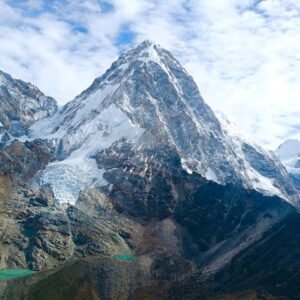
For 10 to 15 unforgettable minutes, you stand in front of an unbroken amphitheater of Himalayan giants: Mount Everest (8,848.86m), Lhotse (8,516m), Nuptse (7,861m), Pumori (7,161m), and Changtse (7,543m).
Ground time is strictly capped at 15 minutes with the helicopter rotors turning to prevent Acute Mountain Sickness (AMS) and high-altitude wind chill.
8:30 AM – 9:30 AM: Descent to Syangboche & Sit-Down Breakfast at Hotel Everest View (3,880m / 12,729ft)
Flight Duration: ~12 Minutes | Ground Time: 35–45 Minutes Dropping 1,665 meters into thicker, warmer air, the helicopter touches down on the wide grassy helipad above Syangboche (3,880m).
Here, a short stone path leads to the terrace of Hotel Everest View—certified by the Guinness Book of World Records as the highest-placed luxury hotel in the world.
Over a hot breakfast of eggs, toast, sausage, pancakes, and freshly brewed Himalayan coffee or masala tea, you have 35 to 45 unhurried minutes to admire Everest, Lhotse, and Ama Dablam in complete comfort.
9:30 AM – 9:55 AM: Flight to Lukla & Quick Return Refueling Stop (2,860m / 9,383ft)
Flight & Refueling Window: ~25 Minutes Boarding the helicopter after breakfast, you glide down the Khumbu valley past Khumjung and Monjo for a quick 10-minute refueling stop at Lukla Airport before clearing the mountain pass for Kathmandu.
9:55 AM – 10:45 AM: Scenic Return Flight from Lukla to Kathmandu (1,350m / 4,429ft)
Flight Duration: ~45–50 Minutes Relax into your seat as the helicopter retraces the foothills of eastern Nepal, offering a final aerial look at snow-capped ridgelines, emerald river valleys, and hillside villages waking up to the day.
10:45 AM – 11:30 AM: Touchdown at Kathmandu Domestic Terminal & Private Hotel Drop-Off
Upon landing at Tribhuvan International Airport, our ground driver meets you at the helipad exit and transfers you back to your Kathmandu hotel—leaving your entire afternoon free for sightseeing, shopping in Thamel, or relaxing by the pool.
Unlike operators that advertise a low headline price and surprise you at the airport with $100+ in hidden shuttle, breakfast, and park permit surcharges, Himalayan Walkers provides complete upfront transparency. You can book this tour either on a Shared Group Seat basis (ideal for solo travelers and couples) or as a Private Helicopter Charter for your own party of 1 to 5 guests.
2026 / 2027 Everest Base Camp Helicopter Tour Cost Table (Shared vs. Private Charter)
Booking Mode & Group Size
Flight & Shuttle Arrangement
Per-Person Cost (USD)
Total Charter Cost (USD)
Best Suited For
Shared Group Joining (1 to 5 Seats per Heli)
Pooled group flight (Max 5 pax total; includes Pheriche 250kg shuttle split above 4,240m)
$1,450 / person
N/A (Per-Seat Booking)
Solo travelers, couples & small groups wanting the lowest per-person fare during peak Spring/Autumn dates.
Comparing Basic, Standard (All-Inclusive) & Luxury Package Tiers
To match different travel styles and budgets, we offer three service tiers. If you'd like to customize your flight or check live group-joining seat availability for tomorrow morning, message our Kathmandu dispatch team 24/7 on WhatsApp at +977 9851350078.
Included Feature
Basic Tier (Seat-Only Shared)
Standard Package (Most Popular)
Luxury VIP Charter Upgrade
Round-Trip Airbus H125 Flight & Kala Patthar Landing
Mountain weather in the Everest region is always given the final word. If low cloud cover, high winds, or poor visibility prevent your helicopter from taking off from Kathmandu on your scheduled morning:
Priority Next-Morning Rescheduling: We automatically roll your booking to the first clear departure window on the following morning at zero extra cost.
100% Weather Refund (Zero Cancellation Penalty): If weather prevents departure and your international flight schedule does not allow you to reschedule for another day, Himalayan Walkers refunds 100% of your tour deposit/payment (minus only actual airport transfer expenses if you have already traveled to the terminal).
What makes the Everest Base Camp Helicopter Tour possible for such a wide range of travelers isn't just the lack of trekking — it's the level of control built into every flight.
Weather windows in the Everest region are read carefully each morning in coordination with Nepal's Civil Aviation Authority before departure, pilots fly the same well-established route daily, and every seat includes oxygen support for the brief time spent above 5,000 meters.
None of it feels improvised. For a journey that reaches higher than most people will ever stand in their lives, the experience is designed to feel calm rather than daring — a considered flight, not a stunt.
Final Thoughts
Not every traveler has the time, the fitness, or the interest for a multi-day trek — and the Everest Base Camp Helicopter Tour exists for exactly that reason. It compresses what would otherwise be the better part of two weeks into a single unforgettable morning: a landing at Kalapatthar, breakfast with a view most people never get to see in person, and a return to Kathmandu before the day is half over.
For anyone who wants a real, close encounter with Everest without walking there, this helicopter tour to Everest Base Camp is the most direct way to get it.
Highlights
A scenic helicopter flight over the Himalayas, with unmatched views of Everest and its neighboring giants
Landing at Kalapatthar (5,545m) — the single best vantage point for Everest, without the two-week trek to reach it
Breakfast at the Everest View Hotel (3,880m), one of the highest-altitude hotels in the world
A luxurious and time-efficient alternative to trekking
Opportunity to capture stunning aerial and ground-level photographs of the Everest region
Comfortable and safe journey with an experienced pilot and crew
Everest Base Camp Helicopter Tour: How the Day Unfolds
5:30 AM
Hotel Pick Up & Transsfer to Domestic Airport
A private vehicle collects you from your Kathmandu hotel for the short transfer to the domestic terminal at Tribhuvan International Airport, where you'll meet your pilot for a brief safety briefing.
6:30 AM to 7:30 AM
Helicopter Takeoff from Kathmandu
The flight climbs out over Bhaktapur, Nagarkot, and Jiri, tracing a path over lush hills and terraced farmland before the terrain begins to rise toward the Himalaya.
7:30 AM to 8:15 AM
Refueling Stop in Lukla (2,860m)
A short landing at Lukla Airport, the traditional gateway to Everest for trekkers on foot, with mountain views while the helicopter refuels.
7:45 AM to 8:45 AM
Everest Base Camp Flyover and Landing at Kalapatthar (5,545m) or Gorakhshep (5164m)
This is the centerpiece of the entire Helicopter tour to Everest Base Camp: an aerial pass over Base Camp itself, the Khumbu Glacier, and the Icefall, followed by a landing at Kalapatthar or Gorakhshep depending on policy changes or weather condition for roughly 10–15 minutes.
Enough time to take in the closest possible view of Everest without ever setting foot on the trekking trail.
One detail worth knowing in advance: helicopters lose significant lift capacity at this altitude, so the landing weight limit at Kalapatthar drops to around 250 kg — roughly 2 to 3 passengers per trip, depending on individual body weight.
If your group is larger than that, the helicopter continues in shuttles from Pheriche or Syangboche, ferrying a few passengers to Kalapatthar at a time while the rest wait nearby with mountain views of their own.
Everyone in the group still lands and experiences Kalapatthar — it simply happens in stages rather than all at once. This is standard practice across helicopter operators in the region and is built into the day's schedule, not a last-minute surprise.
8:15 AM to 9:15 AM
Everest View Hotel (3,880m) for Breakfast
A short flight to one of the highest-altitude hotels on Earth, where breakfast is served with an unobstructed view of Everest and its surrounding peaks. Most guests spend 30–40 minutes here simply taking it in.
9:30 AM to 10:30 AM
Refueling Stop in Lukla
A brief second stop before the return leg to Kathmandu.
10:30 AM to 11:30 AM
Scenic Flight Back to Kathmandu
The return route passes over Namche Bazaar, Tengboche Monastery, and the Dudh Koshi River — the same landmarks trekkers spend days walking past, seen here in minutes from the air.
10:45 AM to 11:45 AM
Arrival in Kathmandu
A private transfer returns you to your hotel, marking the end of the tour — with most of the day still ahead of you.
Cost Includes
Helicopter Flight & Kala Patthar Landing: Round-trip flight from Kathmandu to the Everest region aboard an Airbus H125 (AS350 B3e) helicopter with an aerial pass over Everest Base Camp (5,364m) and a 10–15 minute landing at Kala Patthar (5,545m) or Gorak Shep (5,164m).
Pheriche Shuttle Fees: All high-altitude shuttle handling charges at Pheriche (4,240m) for groups of 4–5 passengers.
Breakfast at Hotel Everest View (3,880m): Full hot mountain breakfast with coffee or tea at the world-famous Hotel Everest View in Syangboche.
All Regional Permits & Aviation Taxes: Covers the Sagarmatha National Park Entry Permit (NPR 3,000), Khumbu Pasang Lhamu Rural Municipality Permit (NPR 3,000), and Tribhuvan International Airport Domestic Passenger Service Charge (NPR 500).
Private Kathmandu Transfers: Round-trip private air-conditioned vehicle transfer between your Kathmandu hotel and the TIA Domestic Helicopter Terminal.
Safety & Oxygen Equipment: Onboard emergency medical oxygen cylinder with regulator and masks, comprehensive first-aid kit, and complimentary loaner down jacket (if requested at briefing).
Licensed Mountain Crew & Government Taxes: Veteran CAAN-licensed high-altitude helicopter captain, airport ground handling staff, 13% Nepal Value Added Tax (VAT), and company service charges.
Cost Excludes
Personal Expenses & Extra Beverages: Alcoholic drinks, bottled cold beverages, snacks, or souvenirs purchased at Lukla or Hotel Everest View.
Basic-Tier Permit & Breakfast Fees (Only if Booking Basic Seat-Only Option): Travelers choosing the stripped-down Basic seat-only rate pay park permits (NPR 6,500 / ~$48 USD cash) and breakfast (~$40–$50 USD) directly on the ground.
Travel & Medical Insurance: Personal travel insurance (optional for this 1-day flight, as onboard oxygen and immediate helicopter descent are already built in).
Gratuities: Customary tips for your helicopter captain and airport driver (optional and at your discretion).
Card Processing Fee: A standard 3.5%–4% international card gateway surcharge applies only if paying by credit card (cash USD/EUR or bank transfer incurs zero fee).
Everest Base Camp Helicopter Tour: Frequently Asked Questions
What is the Everest Base Camp Helicopter Tour
The Everest Base Camp Helicopter Tour is a one-day, 4.5-to-5.5-hour round-trip helicopter excursion from Kathmandu that flies directly over Everest Base Camp (5,364m) and the Khumbu Glacier, lands at Kala Patthar (Kalapatthar, 5,545m / 18,192ft) for close-up views and photographs of Mount Everest, and stops for breakfast at Hotel Everest View (3,880m)—with no trekking or hiking required.
How high does the helicopter fly, and what is the maximum landing altitude?
The helicopter flies at an altitude of 6,000 meters (19,685 feet), with the highest landing point at Kalapatthar (5,545m), offering the best panoramic view of Mount Everest.
How much does the Everest Base Camp Helicopter Tour cost for group joining vs. a private charter?
For the 2026/2027 season, a Shared Group Joining seat starts from $1,350 USD per person (flying with up to 5 passengers total). A Private Helicopter Charter costs $4,500 USD total for 1 to 2 passengers (single non-stop landing), $4,650 to $5,040 USD total for 3 passengers ($1,550–$1,680 per person), and $5,300 USD total for 4 to 5 passengers ($1,060–$1,325 per person) including the Pheriche shuttle fee, Hotel Everest View breakfast, and regional permits.
Do we actually land at Everest Base Camp itself or at Kala Patthar?
Commercial helicopters land at Kala Patthar (5,545m) or Gorak Shep (5,164m) rather than on the moving glacial ice of Everest Base Camp (5,364m). Because Everest Base Camp sits directly below the steep rock wall of Nuptse, you cannot actually see the summit of Mount Everest from Base Camp on the ground. Landing 181 meters higher on the ridge of Kala Patthar gives you a clear, direct, eye-level panorama of Everest's entire summit pyramid, while the helicopter performs a low-altitude scenic pass directly over the Everest Base Camp tent site and Khumbu Icefall.
What helicopter model is used for the Everest Base Camp landing tour?
All flights are operated using high-altitude Airbus H125 (Eurocopter AS350 B3e) helicopters certified to fly up to 23,000 feet (7,010 meters). Powered by a Safran Arriel 2D turbine engine, the Airbus H125 is the safest and most powerful mountain helicopter operating in the Nepal Himalaya and seats up to 5 passengers plus the captain.
How long can we stay on the ground at Kala Patthar (5,545m)?
Due to thin air (roughly 50% of sea-level oxygen) and sub-zero wind chill at 5,545 meters, ground time at Kala Patthar is strictly regulated at 10 to 15 minutes with the helicopter engine running. This provides ample time to step out, take photos and videos against Mount Everest, and soak in the 360-degree Himalayan panorama before descending to 3,880 meters for a relaxed 35-to-45-minute breakfast.
Why is there a 250 kg weight limit and shuttle split at Pheriche (4,240m)?
While an Airbus H125 helicopter can carry up to 500 kg (5 passengers) from Kathmandu to Lukla (2,860m) and Pheriche (4,240m), aviation physics and CAAN regulations cap the maximum landing and takeoff payload above 4,200 meters at 220 to 250 kg (2 to 3 passengers). If your group has 4 or 5 people, the pilot lands at Pheriche and shuttles 2–3 passengers at a time on the 15-minute loop to Kala Patthar so every passenger gets to land safely.
Will I get altitude sickness (AMS) on a 1-day Everest helicopter flight?
Acute Mountain Sickness (AMS) is extremely rare on this tour because your body spends only 10 to 15 minutes above 5,000 meters before immediately descending to 3,880 meters and then back to Kathmandu (1,350m)—far shorter than the multi-hour exposure that triggers altitude illness on a trek. Every helicopter carries supplemental oxygen cylinders and masks at every seat as an added safeguard.
Do I need prior trekking experience or a high fitness level?
No trekking experience or athletic training is required. Because there is zero hiking involved, this tour is accessible to children (ages 5+), seniors (up to age 80), travelers with knee or mobility limitations, and busy professionals with only one free morning in Kathmandu.
Can I join a group as a solo traveler, or do I have to charter a private helicopter?
Solo travelers are welcome to join our daily Shared Group Departures during the Spring (March–May) and Autumn (September–November) seasons, splitting the helicopter with 3 to 4 other travelers for $1,350 USD per person. If you prefer complete privacy or are traveling on an off-peak date, you can charter a private helicopter.
Does every passenger get a window seat on the helicopter?
Yes. In the 5-passenger Airbus H125 cabin, two passengers sit up front beside the captain with wrap-around bubble glass, and three passengers sit in the rear bench with large side windows and an unobstructed forward view. Furthermore, during the Pheriche-to-Kala Patthar shuttle leg (2–3 passengers maximum), every single passenger sits directly next to an outer window.
What permits are required for the Everest Base Camp Helicopter Tour, and are they included?
Landing in the Khumbu requires two local permits—the Sagarmatha National Park Entry Permit (NPR 3,000) and the Khumbu Pasang Lhamu Rural Municipality Permit (NPR 3,000)—plus the Kathmandu Domestic Airport Tax (NPR 500), totaling NPR 6,500 (~$48 USD) per person. In our Standard and Luxury packages, all permits, taxes, and breakfast are 100% included in your price.
How is this tour different from the 10-Day Everest Base Camp Trek with Helicopter Return?
Our 10-Day Everest Base Camp Trek with Helicopter Return is a true physical trekking expedition where you hike 65 kilometers uphill on foot over 8 days to reach Base Camp and Kala Patthar, then take a helicopter from Gorak Shep back to Kathmandu. This 1-Day Everest Base Camp Helicopter Tour involves no walking in either direction—you fly both ways from Kathmandu in a single morning.
What happens if the flight is delayed or canceled due to bad weather?
Passenger safety always comes first. If morning weather in Kathmandu or the Khumbu is unsafe for flying, we first hold at the domestic terminal for a mid-morning clearing window. If the flight cannot depart that day, we reschedule you to the next clear morning at no extra charge, or issue a 100% refund if you do not have a spare day in Nepal.
How far in advance should I book, and what details do you need?
During peak Spring (March–May) and Autumn (September–November) months, we recommend booking 1 to 3 weeks in advance to secure early-morning 6:30 AM departure slots, though last-minute next-morning bookings can often be arranged via WhatsApp (+977 9851350078). To confirm your seat, we simply need a photo of your passport bio page, your approximate body weight (in kg or lbs) for flight load calculation, and your Kathmandu hotel name for pickup.