

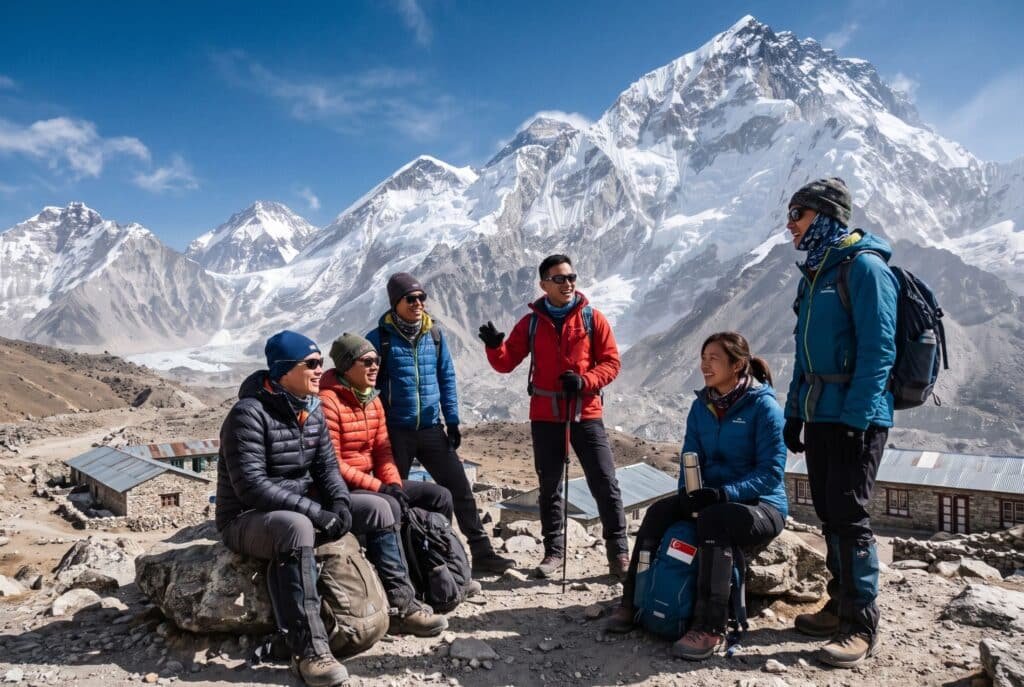
In an era dominated by screens and social media, planning a family vacation that delivers genuine adventure, cultural perspective, and real connection can be challenging. For active families, few travel experiences match the transformative impact of hiking through the Sherpa heartland of the Nepal Himalayas.
Walking through Sagarmatha National Park, crossing steel suspension bridges above glacier-fed rivers, and standing together at Everest Base Camp (5,364 m) is a milestone that builds lifelong character, resilience, and family pride.
Yet, parents evaluating an Everest Base Camp family trek face real concerns: Can teenagers handle the walking distances? What about altitude sickness? Will repetitive downhill walking lead to exhaustion and family friction?
The answer lies in modern itinerary design. By taking the classic trail upward and returning to Kathmandu via scenic helicopter, an Everest Base Camp family trek transforms from an exhausting two-week grind into an inspiring, tightly managed 10-day journey.
Here is the comprehensive guide to safety, minimum age guidelines, school holiday scheduling, and why flying down makes family trekking feasible.
1. What Is the Ideal Age for an Everest Base Camp Family Trek?
While younger children regularly enjoy lower-altitude cultural treks in the Annapurna or Langtang foothills, high-altitude terrain requires physiological maturity.
- Recommended Age Range: 14 Years and Older: We strongly recommend that teenagers be at least 14 years old for an Everest Base Camp family trek. Teenagers have developed the lung capacity, joint stability, and emotional stamina needed for 5 to 7 hours of daily walking.
- Ability to Verbalize Symptoms: The primary medical rule at high elevation is clear communication. Trekkers must be able to accurately report subtle early signs of altitude discomfort (such as dull headaches, dizziness, or nausea) rather than masking symptoms. Teenagers can communicate their physical state maturely with guides.
2. Why the Helicopter Return Is Critical for Family Travel
On a traditional 14-day trek, reaching Base Camp is only the halfway mark. Ahead lies roughly 65 kilometers of retracing your exact steps back to Lukla over four consecutive days of knee-straining descents.
For families, this downhill phase is where morale frequently breaks down:
- Mental Fatigue: After achieving the high point at Base Camp, teenagers often lose interest in walking back along the exact same trail.
- Knee and Joint Impact: Descending thousands of stone stairs causes significant joint inflammation and blisters, leading to exhaustion and irritability.
- School Holiday Constraints: Parents must balance work leave with school holiday terms (Easter, Thanksgiving, or Singapore and Australian term breaks).
The Helicopter Solution
By choosing our 10-day Everest Base Camp Trek with Helicopter Return, your family enjoys the full climbing accomplishment:
- You hike every kilometer up to Everest Base Camp (5,364 m) and Kala Patthar (5,545 m) together.
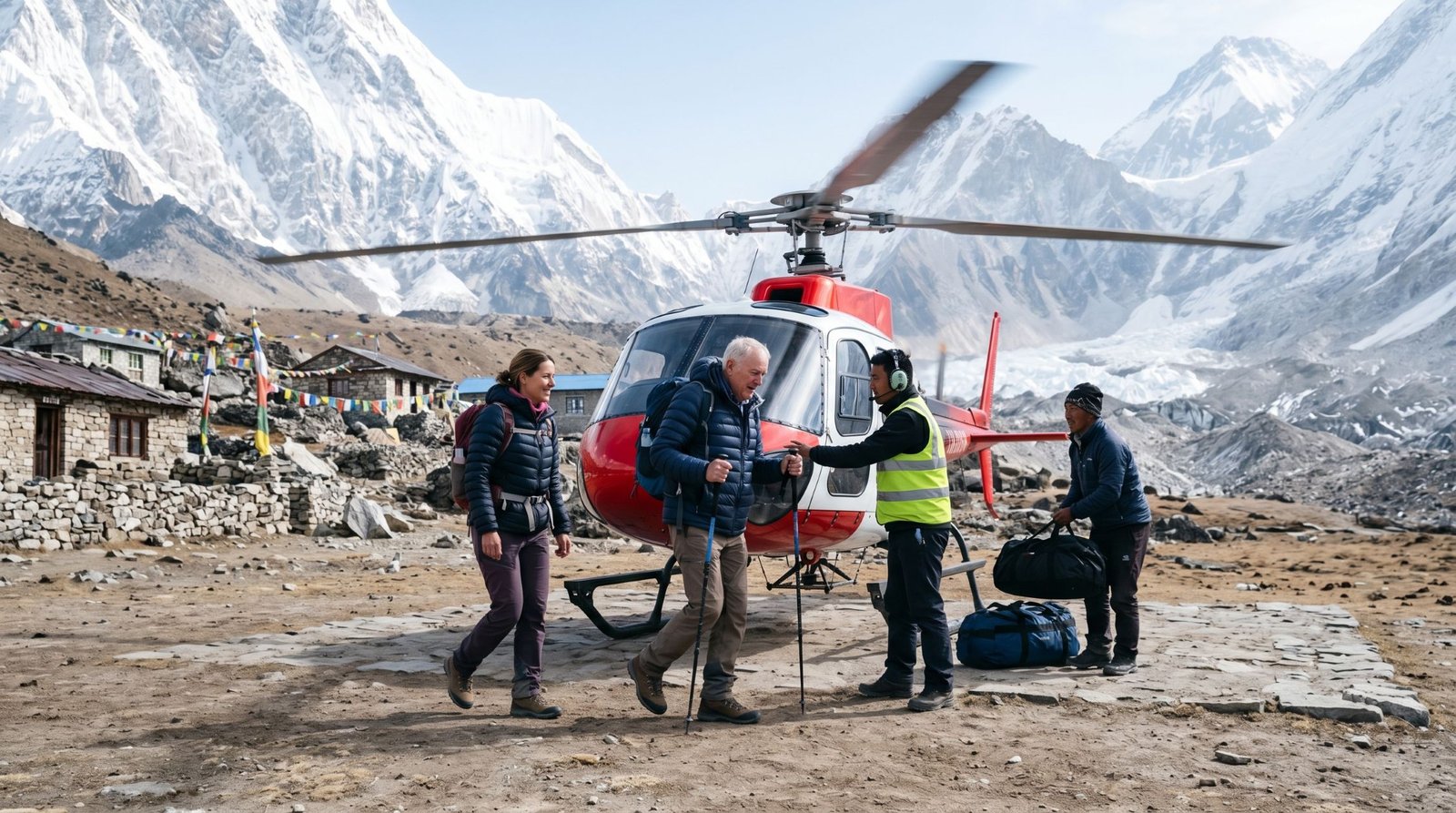
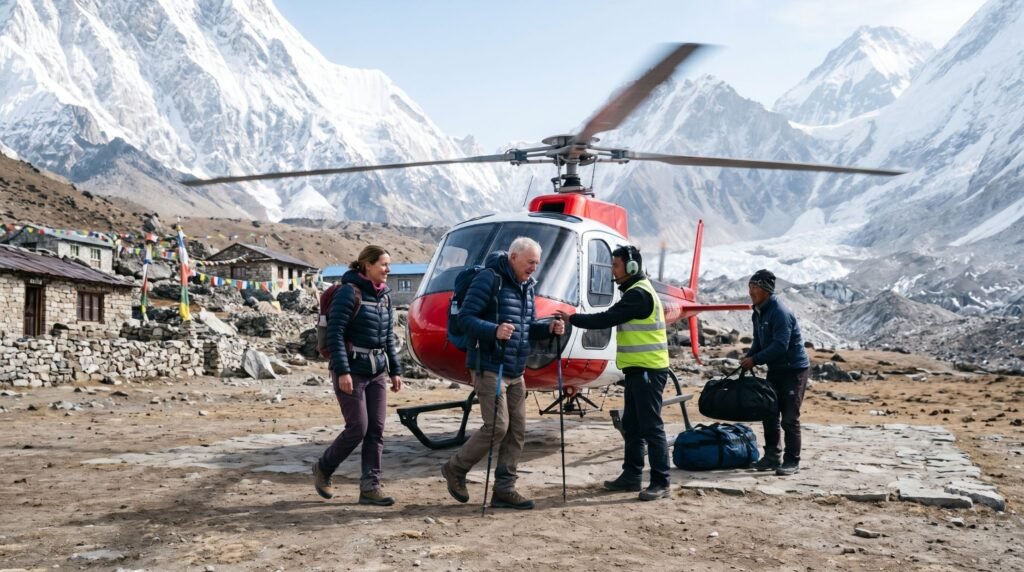
- Instead of enduring a repetitive 4-day march back down, a chartered helicopter picks up your family at Gorak Shep (5,140 m) and delivers you back to Kathmandu in under 60 minutes.
- Your family adventure concludes on a high note with an aerial view of Mount Everest, keeping spirits high and fitting cleanly into a standard school break.
3. Altitude Safety and Pacing Protocols for Families
When organizing an Everest Base Camp family trek, conservative acclimatization pacing is mandatory.
Younger hikers often want to walk fast, while parents may prefer a measured cadence. Our certified Sherpa guides ensure the family moves as a unified team using proven high-altitude safety protocols:
- Enforcing the “Bistari” (Slow) Cadence: Our guides lead from the front, setting a steady, conversational pace that keeps teenagers from overexerting themselves early in the day.
- Daily Biometric Monitoring: Twice daily (morning and evening), our lead guide uses a pulse oximeter to record every family member’s blood oxygen saturation and resting heart rate, identifying early signs of altitude fatigue before they escalate.
- Preserving Acclimatization Rest Days: Our 10-day itinerary never cuts safety days. We spend two nights in Namche Bazaar (3,440 m) with an active hike to 3,880 m, and two nights in Dingboche (4,410 m). Time is saved solely by flying back from Base Camp.
4. Teahouse Life: Cultural Immersion for Teenagers
One of the greatest benefits of an Everest Base Camp family trek is the cultural perspective it offers young travelers:
- Sherpa Hospitality: Staying in local teahouses introduces teenagers to traditional Buddhist culture, mani stone carvings, and monastery life in Tengboche.
- Screen-Free Evenings: Gathering around the central dining stove in the evenings encourages board games, reading, and shared conversations without digital distractions.
- Nutritious Mountain Food: Teahouses provide hearty, freshly prepared meals—from traditional Dal Bhat (lentil soup with rice and vegetables) to momos (dumplings), pasta, fried noodles, and porridge.
5. Family Packing & Porter Support: Keeping Daypacks Light
Parents should not carry their children’s heavy gear on the trail. On all Himalayan Walkers family departures:
- Porters Handle Heavy Duffels: Our porters transport your primary duffel bags (up to 10 kg per person in provided company duffels).
- Light Personal Daypacks: Parents and teenagers carry only a lightweight daypack (3 to 4 kg) containing personal water bottles, warm layers, rain gear, and a camera.
- Rental Gear in Kathmandu: Heavy down jackets and -20°C sleeping bags can be rented affordably in Kathmandu upon arrival, saving luggage space on international flights.
Frequently Asked Questions
What happens if a family member feels unwell at high altitude?
Our guides are certified in wilderness first aid and carry emergency oxygen cylinders. If a family member shows signs of altitude sickness that do not improve with rest, our team coordinates an immediate descent to a lower elevation. In the rare event of emergency evacuation, our Kathmandu operations office arranges immediate helicopter rescue directly to a hospital in Kathmandu.
Can our family book a private departure?
Yes. We frequently arrange private family departures where daily walking hours, meal stops, and rest breaks are customized entirely around your family’s personal rhythm.
Create a Family Memory That Lasts a Lifetime
Standing as a family at the base of the world’s tallest mountain teaches resilience, teamwork, and an appreciation for the natural world. With professional guide support and the convenience of a helicopter return, your family can conquer Everest Base Camp safely and comfortably.
Explore our 10-Day Everest Base Camp Trek with Helicopter Return package and start planning an unforgettable family journey.

