
Standing at 5,364 meters on the Khumbu Glacier with the icy towers of the Khumbu Icefall rising above you is one of the most unforgettable moments in adventure travel.
On a traditional 14-day itinerary, however, reaching Base Camp is only part of the challenge. Ahead lies a grueling 65-kilometer descent back to Lukla—three to four days of retracing the exact same trail and pounding tired knees against steep, rocky terrain.
This comprehensive Everest Base Camp Helicopter Return Guide is designed to demystify one of the most popular modern alternatives: trekking up on foot to earn the climbing achievement, and flying back from Gorak Shep to Kathmandu in a scenic chartered helicopter.
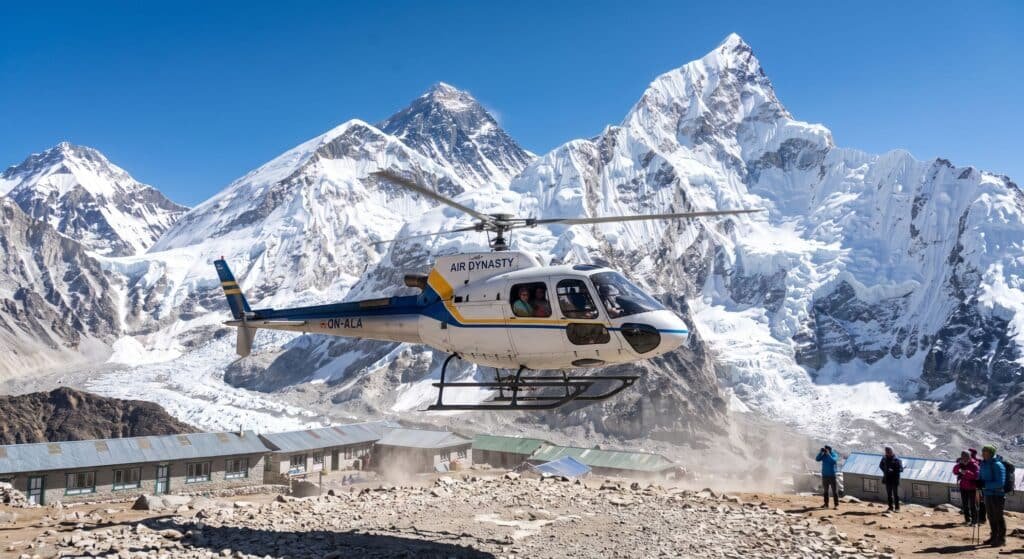
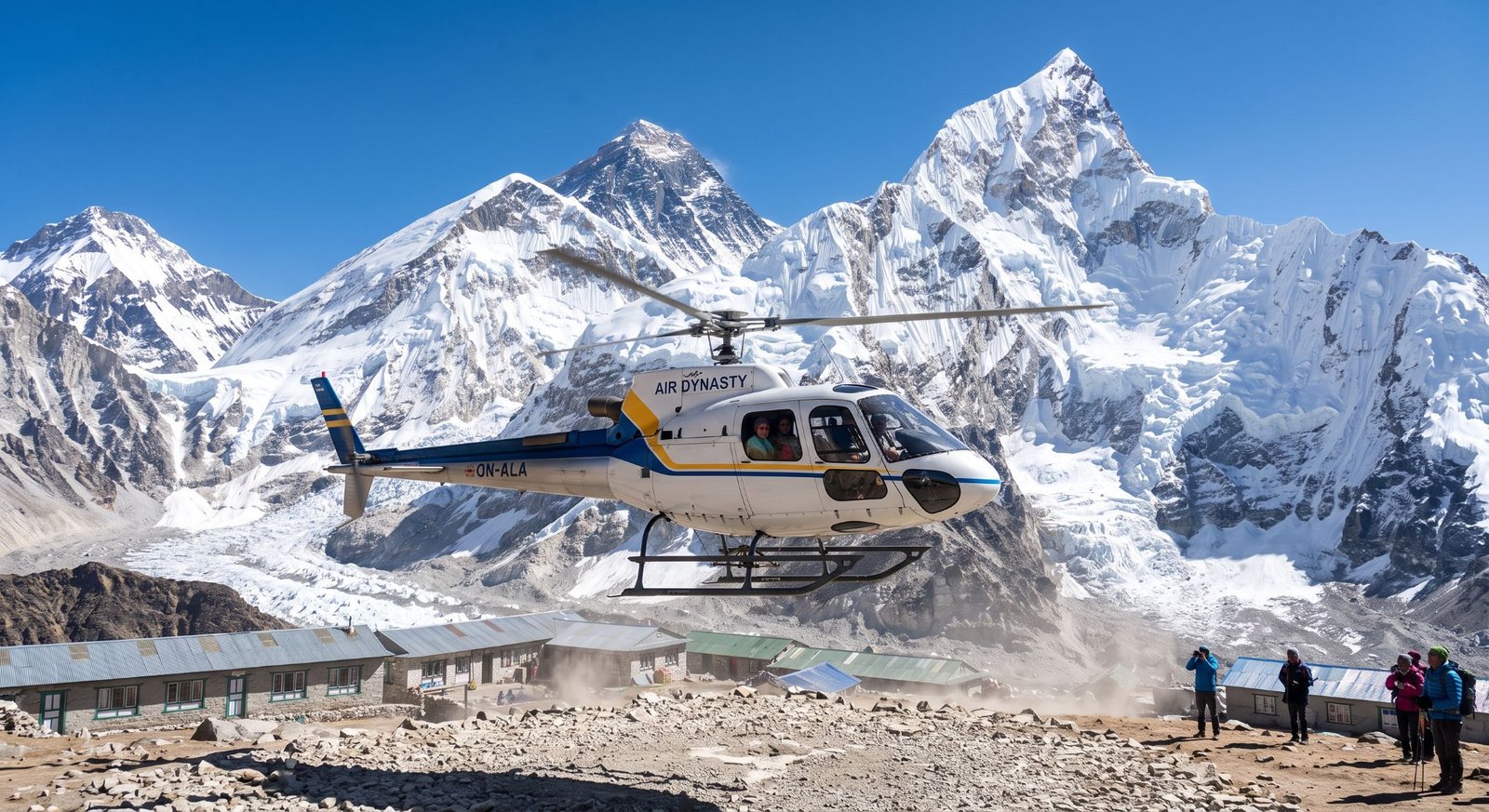
While flying back saves nearly half a week of travel time and provides stunning aerial views of the Himalayas, many operators gloss over the operational realities of high-altitude aviation. Below, we break down the physics of mountain take-offs, the Gorak Shep shuttle system, strict weight restrictions, true teahouse expenses, and essential weather contingency protocols.
If you are evaluating your options or preparing for an upcoming journey, use this Everest Base Camp Helicopter Return Guide to plan your trek smoothly and safely.
1. Why You Need an Everest Base Camp Helicopter Return Guide: The Gorak Shep “Shuttle” System
One of the most widespread misconceptions among prospective trekkers is that a helicopter simply lands at Gorak Shep, boards five adult passengers with all their trekking duffels, and flies non-stop to Kathmandu. In high-altitude mountain aviation, that is physically impossible.
The Physics of Extreme-Altitude Take-Offs
Gorak Shep sits at an elevation of 5,140 meters (16,863 feet). At this altitude, air density is roughly 50% thinner than at sea level. Because thin air provides less aerodynamic lift and reduces engine performance, Civil Aviation Authority of Nepal (CAAN) regulations strictly limit the take-off payload of the Airbus H125 (Eurocopter AS350 B3e) to approximately 220–250 kg (485–550 lbs) at this elevation.
How the High-Altitude Shuttle Works in Practice
Because an average group of 4 to 5 trekkers plus gear weighs between 350 kg and 450 kg, helicopter operators must conduct a coordinated shuttle operation:
- First Lift from Gorak Shep (5,140 m): The helicopter loads 2 or 3 passengers with part of the luggage and flies a quick 10-minute downhill hop to the lower helipad at Pheriche (4,240 m) or Lukla (2,840 m).
- Second Lift: The pilot returns immediately to Gorak Shep to collect the remaining 2 passengers and gear.
- Recombining for Kathmandu: At Pheriche or Lukla, atmospheric pressure is substantially higher. The helicopter can safely carry all 5 passengers and their combined baggage. After a rapid refuel, the aircraft completes the remaining 45-to-50-minute flight directly to Tribhuvan International Airport in Kathmandu.
A key purpose of this Everest Base Camp Helicopter Return Guide is to reassure travelers: this shuttle is completely normal, standard operational procedure designed for safety.
2. Why Helicopters Do Not Pick Up Directly from Base Camp
A frequent question from travelers is: “Why can’t the helicopter pick us up directly from the Base Camp rock?”
For scheduled commercial treks, helicopters are prohibited from landing at Base Camp for two reasons:
- Glacier Dynamics & Safety: Everest Base Camp (5,364 m) is pitched directly on the moving ice and shifting moraine of the Khumbu Glacier. Landing commercial passenger helicopters on active glacial ice presents unnecessary aviation hazards.
- Environmental & Conservation Regulations: Sagarmatha National Park authorities and mountaineering expedition teams strictly limit helicopter landings at Base Camp to emergency medical search-and-rescue flights.
All commercial passenger flights depart from the permanent stone helipad at Gorak Shep (5,140 m), located 3 kilometers (about a 2-hour walk) from Base Camp.
On our supported 10-Day Everest Base Camp Trek with Helicopter Return, you hike to Base Camp on Day 9, sleep at Gorak Shep, tackle the sunrise climb up Kala Patthar (5,545 m) early on Day 10, and board your helicopter after breakfast.
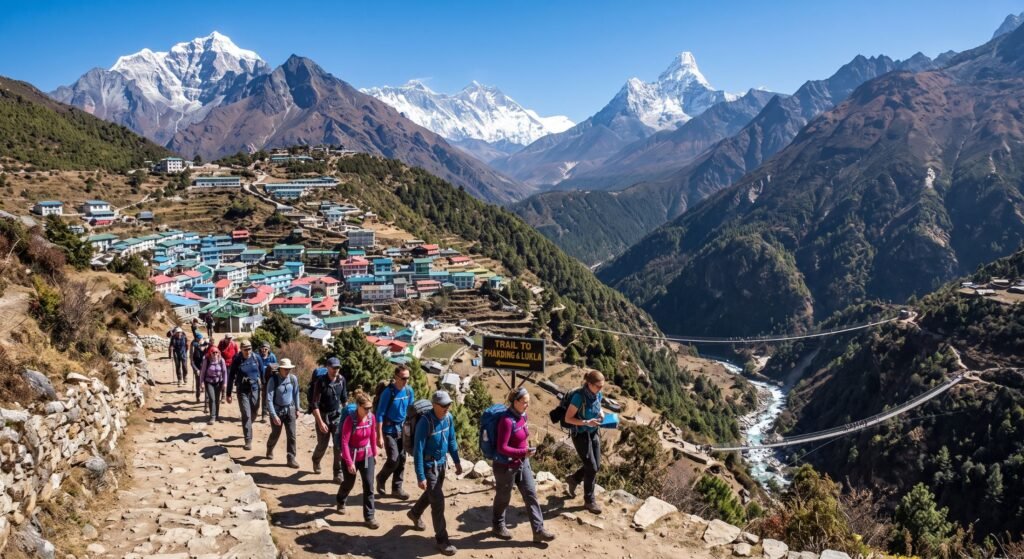
3. Everest Base Camp Helicopter Return Guide: Acclimatization and Itinerary Safety
In recent years, some agencies have begun advertising ultra-short 7-day or 8-day helicopter return itineraries. Any responsible Everest Base Camp Helicopter Return Guide must advise extreme caution regarding these rushed schedules.
On an Everest trek, trail distance is manageable—rapid altitude gain is dangerous.
Kathmandu (1,350m) ➔ Lukla (2,840m) ➔ Namche (3,440m) ➔ Dingboche (4,410m) ➔ Lobuche (4,940m) ➔ Gorak Shep (5,140m) ➔ Kala Patthar (5,545m)
Skipping rest days dramatically increases the incidence of Acute Mountain Sickness (AMS), High Altitude Pulmonary Edema (HAPE), and emergency helicopter evacuations.
| Itinerary Component | Rushed 7–8 Day Itineraries | Balanced 10-Day Heli Itinerary |
|---|---|---|
| Namche Bazaar (3,440 m) | 1 night only (Zero rest days) | 2 nights (Active hike to 3,880m) |
| Dingboche (4,410 m) | Skipped / 1 night only | Built-in acclimatization rest |
| Kala Patthar Sunrise (5,545 m) | Often abandoned due to fatigue | Included on Day 10 morning |
| Evacuation Risk | High | Low to Moderate |
| Where Time is Saved | By skipping safety days | By eliminating the 3-day walk down |
A well-planned 10-day itinerary preserves the exact same ascending pace as standard 14-day treks. The time savings come solely from replacing the downhill trek with a 60-minute flight.
4. Flight Logistics: Kathmandu vs. Ramechhap (Manthali) Airport
When preparing for your trip, be aware that you may not fly to Lukla directly from Kathmandu.
To alleviate air traffic congestion at Kathmandu’s international airport, the Civil Aviation Authority of Nepal (CAAN) redirects all scheduled fixed-wing flights to Lukla through Manthali Airport in Ramechhap during peak trekking seasons:
- Spring Peak: March, April, and May
- Autumn Peak: October and November
What to Expect During Peak Months:
- You will leave your Kathmandu hotel by private vehicle transfer between 1:00 AM and 2:00 AM.
- The highway drive to Ramechhap takes roughly 4 to 5 hours.
- From Ramechhap, you board a quick 20-minute flight to Lukla, landing in time to begin trekking to Phakding before noon.
During off-peak months (December–February and June–August), flights generally operate directly out of Kathmandu Domestic Terminal. Direct helicopter flights from Kathmandu to Lukla are also available as a private upgrade.
5. Strict Luggage Allowances: Mastering the 15 kg Rule
Both fixed-wing flights into Lukla and helicopters returning from Gorak Shep enforce strict weight limits.
- Total Baggage Allowance: 15 kg (33 lbs) per trekker
- Duffel Bag (Carried by Porter): 10 kg (22 lbs)
- Daypack (Carried by You): 5 kg (11 lbs)
What to Do with City Clothes and Suitcases:
Do not carry non-trekking items into the mountains. When booking our Everest Base Camp Trek with Helicopter Return, we provide a complimentary high-altitude duffel bag. You pack only your trail essentials into the duffel, and store your suitcases, urban clothing, and extra electronics in our locked storage facility in Kathmandu at no extra charge.
6. Everest Base Camp Helicopter Return Guide: Real Out-of-Pocket Expenses
While all-inclusive packages cover permits, flights, guides, porters, teahouse rooms, and main meals, high-altitude teahouses operate independently and charge modest fees for electricity and amenities.
Credit cards are rarely accepted past Namche Bazaar. Trekkers should carry $250 to $350 USD equivalent in Nepali Rupees (NPR) cash from Kathmandu.
| Incidental Service | Typical Trail Cost | Practical Money-Saving Tip |
|---|---|---|
| Hot Shower (Gas/Solar) | $4 to $6 per shower | Use wet wipes above Dingboche to maintain hygiene without catching a chill. |
| Device Charging | $3 to $5 per device | Bring a 20,000mAh power bank and keep it inside your sleeping bag at night. |
| Wi-Fi Cards (Everest Link) | $5 to $10 for 10 GB | An Ncell or Airlo eSIM works up to Tengboche; buy Everest Link cards higher up. |
| Boiled Drinking Water | $2 to $4 per liter | Bring a reusable insulated bottle with water purification tablets (Aquatabs). |
| Guide & Porter Tips | $120 to $150 total | Customary in Nepal, presented at the end of the trip to thank your mountain crew. |
7. Mountain Weather Delays and Safety Contingencies
High-altitude mountain weather changes quickly. Morning skies in the Everest region are usually clear, which is why commercial helicopter returns operate between 7:00 AM and 11:00 AM.
By midday, rising thermal currents and valley fog can cause flight windows to close.
Our Weather Protocol:
- Satellite Weather Monitoring: If low cloud cover temporarily impacts Gorak Shep, our Kathmandu dispatch office tracks live satellite forecasts for clearing windows.
- Safe Lowering Alternative: If an extended cloud ceiling forms at 5,000 meters, your guide will escort you down to Pheriche (4,240 m) or Pangboche (3,985 m). Lower elevations clear up much faster, enabling helicopters to land safely.
- Buffer Days in Kathmandu: We strongly recommend scheduling at least 1 or 2 buffer days in Kathmandu before your international flight home to account for potential weather holds.
8. Summary: Who Is the Helicopter Return Trek Best For?
As outlined in this Everest Base Camp Helicopter Return Guide, this package is an exceptional choice if:
- You have a 10-to-12-day vacation window and cannot take two full weeks away from work.
- You want the authentic physical challenge of trekking to Everest Base Camp and Kala Patthar on foot.
- You want to spare your knees and joints the strain of a 3-day downhill descent.
- You want to finish your Himalayan journey with a world-class aerial view of the Everest range.
Book Your 2026/2027 Adventure
Ready to experience Everest Base Camp without the long walk back? Check out our guaranteed departures, transparent pricing, and all-inclusive details on the 10-Day Everest Base Camp Trek with Helicopter Return.
Frequently Asked Questions
What helicopter models are used for the EBC return flight?
Flights are operated by certified Nepalese helicopter operators utilizing the Airbus H125 (Eurocopter AS350 B3e). Known for its exceptional power-to-weight ratio, this helicopter holds the world record for the highest landing on Mount Everest.
Can beginners complete this trek?
Yes. You do not need technical climbing skills or prior high-altitude experience. However, good cardiovascular fitness is essential. We recommend 6 to 8 weeks of regular hiking, running, or stair climbing before arrival.
Is Kala Patthar included in the helicopter return itinerary?
Yes. On our 10-day itinerary, you hike to Everest Base Camp on Day 9, overnight at Gorak Shep, and hike to Kala Patthar (5,545 m) early on Day 10 for sunrise over Mount Everest before boarding your helicopter.

