
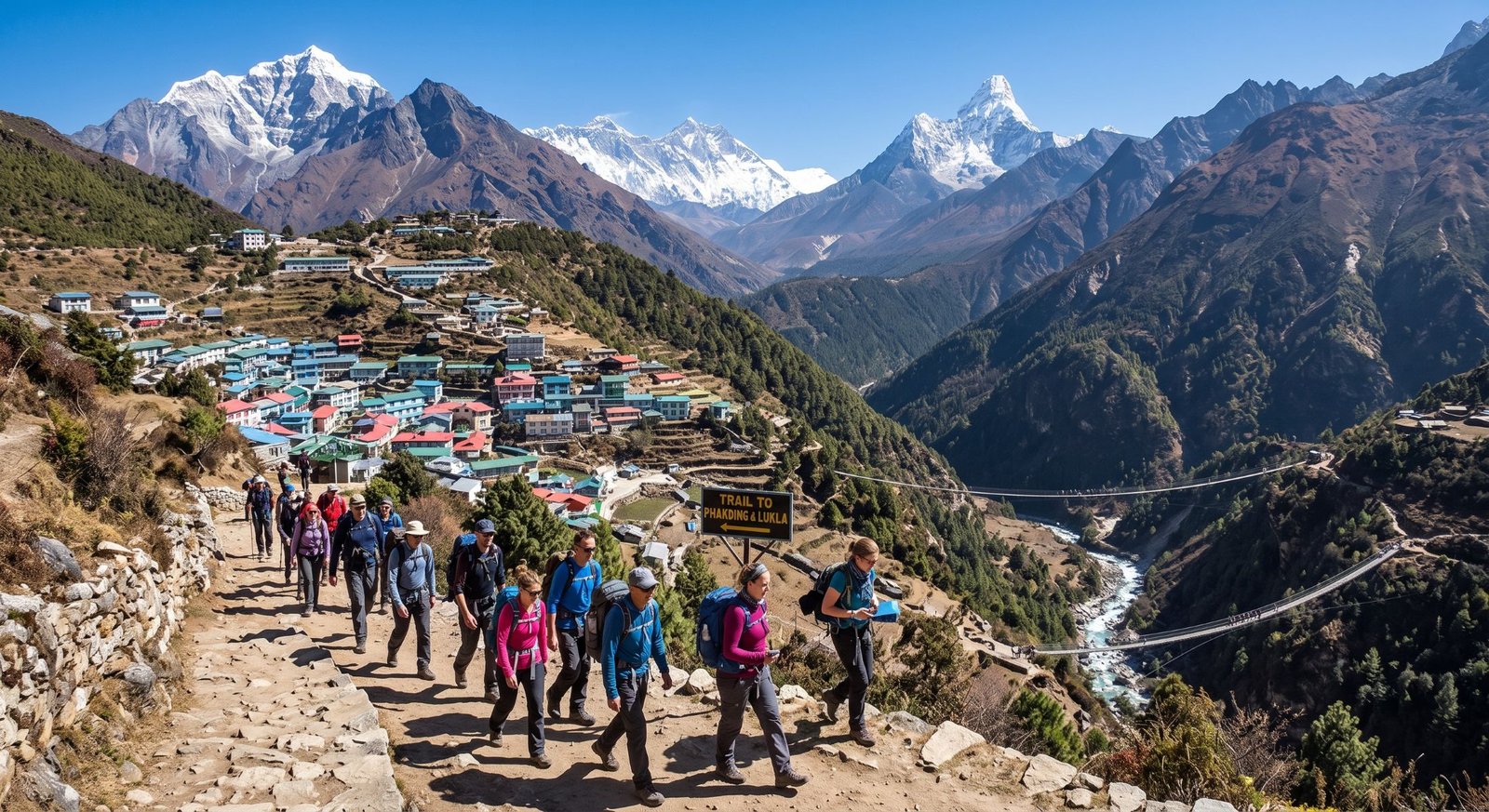
The easiest way to trek Everest Base Camp as a first-timer is not skipping the hike—it is skipping the grueling 65-kilometer walk back down.
Most beginners assume that standing at Everest Base Camp (5,364m) requires years of mountaineering experience, technical climbing gear, or marathon-level fitness. In reality, the Khumbu trail uses zero ropes and zero crampons. What actually breaks first-time trekkers on a classic 14-day itinerary is rarely the slow, steady walk up to Base Camp.
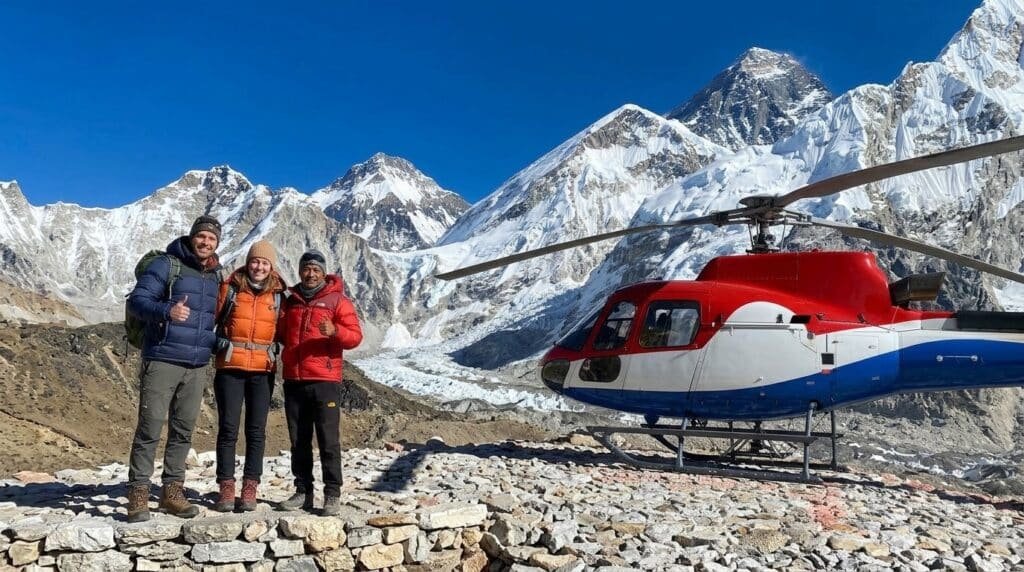
It is what hits immediately after: three to four consecutive days of pounding back down steep stone staircases on exhausted knees, followed by the stress of waiting for weather-dependent twin-otter flights out of Lukla.
That single reality is why pairing a full on-foot ascent with a helicopter flight back from Gorak Shep has become the easiest way to trek Everest Base Camp without giving up the real achievement.
You still earn every meter of elevation under your own power, stand beside the Khumbu Icefall, watch sunrise from Kala Patthar (5,545m), and sleep in Sherpa teahouses—then trade the repetitive return march for a 60-minute panoramic helicopter flight straight back to Kathmandu.
If you are planning your very first high-altitude trek, this guide covers the real day-by-day pacing, altitude decisions, insider flight and baggage rules, and an 8-week training plan so you know exactly what to expect before you book.
Why a Helicopter Return Is the Easiest Way to Trek Everest Base Camp
For first-time trekkers, two factors decide whether you genuinely enjoy the Himalayas or merely endure them: cumulative physical fatigue and logistical stress. Replacing the walk out with a helicopter directly solves both, making this route the easiest way to trek Everest Base Camp on foot.
- Half the total mileage (~65 km instead of ~130 km): You hike every kilometer of the iconic outbound trail from Lukla to Everest Base Camp and Kala Patthar, then skip retracing the exact same 65-kilometer path in reverse.
- Zero knee-punishing descent: Downhill hiking puts three to four times your body weight of impact through your knees and quads—especially on the long stone descents from Tengboche and Namche Hill. Flying out from Gorak Shep protects your joints when your legs are at their most fatigued.
- Less exposure to Lukla return bottlenecks: Standard treks rely on fixed-wing flights departing Lukla at the end of the trip, which can back up for days when valley clouds roll in. Charter helicopters returning from Gorak Shep offer greater routing flexibility back to Kathmandu, helping protect your international flight home.
- Two unforgettable perspectives in one trip: You experience the intimacy of the trail—prayer flags, yak caravans, monastery bells, and teahouse warmth—followed by an aerial panorama gliding over the Khumbu Glacier, Ama Dablam, and Tengboche on your final morning.
To see the exact daily elevation profile, inclusions, and current dates, explore our Everest Base Camp Trek with Helicopter Return package.
Classic 14-Day Trek vs. 10-Day Helicopter Return: A Beginner’s Comparison
If you are trying to decide on the easiest way to trek Everest Base Camp for your fitness level and vacation schedule, comparing the classic round-trip route against the 10-day helicopter return makes the trade-offs crystal clear.
| Trekking Factor | Classic 14-Day Round-Trip Trek | 10-Day Helicopter Return Trek |
| Total Distance Walked | ~130 km (80 miles) out and back | ~65 km (40 miles) ascent only |
| Built-In Acclimatization | 2 rest days (Namche & Dingboche) | 1 rest day in Namche (customizable to 11 days with Dingboche added) |
| Downhill Joint Impact | High — 3 to 4 long days descending stone steps | Minimal — replaced by a ~60-minute helicopter flight |
| Highest Point Reached | Kala Patthar (5,545 m / 18,192 ft) | Kala Patthar (5,545 m / 18,192 ft) |
| Lukla Return Flight Risk | High reliance on fixed-wing Lukla return flights | Direct helicopter return from Gorak Shep to Kathmandu |
| Starting Cost | ~$1,350 – $1,650 per person | ~$3,200 per person (all-inclusive) |
| Best Suited For | Budget trekkers with 2+ weeks and strong knees | Beginners wanting the full EBC milestone with half the wear and tear |
Notice what stays intact: the achievement. Unlike a 4-hour Everest helicopter sightseeing tour where you never hike a kilometer, you walk the entire Khumbu Valley to Base Camp and climb Kala Patthar yourself. The helicopter simply turns the hardest, most repetitive part of the journey into your grand finale.
The 10-Day Beginner Route: What Each Stage Actually Feels Like
Knowing how the trail unfolds day by day takes the guesswork out of the easiest way to trek Everest Base Camp. Here is what each stage feels like on the ground.
Days 1–3: Kathmandu Briefing, Lukla Flight & First Steps to Phakding
Your trip starts in Kathmandu (1,350m) with a 4-star hotel stay in Thamel, a thorough gear check, and a face-to-face orientation briefing with your licensed guide. After a thrilling morning flight into Lukla (2,860m), Day 3 gives your legs a gentle warm-up: a 7.5 km (3–4 hour) walk beside the glacial-blue Dudh Koshi River to Phakding, dropping a slight net elevation (-230m) so you ease into mountain walking without strain.
Days 4–5: Entering Sagarmatha National Park & Acclimatizing in Namche Bazaar
Crossing high suspension bridges strung with prayer flags, you enter UNESCO-listed Sagarmatha National Park—a 124,400-hectare alpine sanctuary of deep gorges, hanging glaciers, and historic Sherpa villages. The steady climb up Namche Hill brings you to Namche Bazaar (3,440m), the amphitheater-shaped trading hub of the Everest region.
Day 5 is your built-in acclimatization day. Following the mountaineering rule of “climb high, sleep low,” you take a 5 km (3–4 hour) hike up toward the Everest View Hotel ridge (~3,880m) for your first clear sight of Mount Everest and Ama Dablam, then descend back to Namche’s bakeries and cozy lodges for the night.
Days 6–7: Tengboche Monastery & Above the Treeline to Dingboche
Leaving Namche, the trail contours high along the valley wall before climbing to Tengboche (3,860m), home to the Khumbu’s largest Tibetan Buddhist monastery. Listening to monks chant at dusk while Ama Dablam glows pink outside the courtyard is a highlight almost every beginner remembers for life.
Day 7 (10.5 km, 5–6 hours) carries you above the treeline into the wide, wind-carved Imja Valley and Dingboche (4,410m), where pine forests give way to stone-walled pastures and towering views of Lhotse’s south face.
Days 8–9: Lobuche, Gorak Shep & Standing at Everest Base Camp (5,364m)
On the standard 10-day schedule, Day 8 climbs steadily from Dingboche past the poignant climbers’ memorials at Thukla Pass to Lobuche (4,910m) beside the Khumbu Glacier moraine. (Note for cautious beginners: if you prefer a slower altitude transition, we can easily insert a second acclimatization day in Dingboche to create a custom 11-day itinerary.)
Day 9 is the milestone you trained for: a 12 km (7–8 hour) trek from Lobuche to Gorak Shep (5,164m), pausing for lunch before walking across rocky glacial terrain to Everest Base Camp (5,364m). Standing beneath the jagged ice seracs of the Khumbu Icefall—knowing your own two feet carried you there—is pure magic. You return to Gorak Shep for one final high-altitude night.
Day 10: Kala Patthar Sunrise & Your 60-Minute Helicopter Return
Before dawn, you hike 3.5 km round-trip (2.5–3 hours) up Kala Patthar (5,545m) for the iconic, unobstructed sunrise view straight onto Mount Everest’s summit pyramid. After breakfast back at Gorak Shep, you walk to the helipad and lift off over the Khumbu Glacier—touching down at Kathmandu Airport roughly 60 minutes later, in time for a hot shower and celebratory lunch at your hotel.
Local Insider Logistics Every Beginner Should Know Before Booking
Many generic trekking blogs gloss over how Khumbu aviation actually works on the ground. Understanding two real operational details upfront is part of planning the easiest way to trek Everest Base Camp with zero surprises.
1. The Ramechhap (Manthali) Airport Flight Reality
During peak trekking seasons (Spring: March–May, and Autumn: October–November), Nepal’s civil aviation authorities routinely shift fixed-wing Lukla flights from Kathmandu to Manthali Airport in Ramechhap to reduce air traffic congestion. When this rule is active, we arrange a private, air-conditioned transfer leaving Kathmandu around 1:00–2:00 AM for the 4 to 5-hour drive to Manthali, where you board a shorter 20-minute flight straight into Lukla. Knowing this ahead of time helps you pack a neck pillow and treat the early start as part of the adventure rather than an unexpected shock.
2. High-Altitude Helicopter Weight, Baggage Limits & Shuttles
At Gorak Shep’s elevation (5,164m), thin mountain air reduces helicopter lift. For safety, pilots enforce strict high-altitude payload limits of roughly 220 to 250 kg (typically 2 to 3 passengers plus gear per lift). If you are trekking in a group of 4 or 5, the helicopter performs two quick 10-minute shuttles down to a lower-altitude landing pad at Pheriche or Lukla, where everyone regroups into a single helicopter for the smooth flight back to Kathmandu.
High-altitude helicopter sectors also enforce a 10–15 kg baggage allowance per person (occasionally capped at 10 kg on high-elevation lifts). Sticking to your 10–12 kg porter duffel limit already keeps your gear safely within helicopter rules, and any extra city luggage can be stored free of charge at your Kathmandu hotel while you trek.
Keep in mind that this pre-booked helicopter return is a scheduled transfer—not a substitute for emergency medical evacuation insurance, which remains mandatory in case an unplanned rescue is ever needed earlier on the trail.
Trail Insight from Our Sherpa Team: Most first-time trekkers feel strong and energized walking up to Everest Base Camp, only to realize at Gorak Shep how exhausting four straight days of downhill stone steps would be. Flying back from Gorak Shep lets beginners finish their first Himalayan trek smiling rather than limping.
Altitude Safety & Choosing Between 10 Days and 11 Days
Respecting thin air is essential on even the easiest way to trek Everest Base Camp. Above 2,500 meters, lower air pressure means every breath delivers less oxygen. As the CDC Yellow Book guidelines on high-altitude travel explain, Acute Mountain Sickness (AMS) can affect anyone—regardless of age or gym fitness—if they ascend too quickly.
Should You Book the 10-Day Standard Route or Add an 11th Day?
- Choose the standard 10-day itinerary (1 acclimatization day in Namche) if you are reasonably fit, have a strict 10-day vacation window, and have handled moderate elevation (2,500m–3,500m) well in the past.
- Ask for the custom 11-day option (adding a 2nd acclimatization day in Dingboche) if you have never slept above 2,500 meters before, want the most conservative possible buffer before crossing 5,000 meters, and have one extra day in your schedule.
Whichever option you pick, our guides enforce slow, conversational pacing (bistari, bistari), monitor your blood oxygen saturation (SpO2) every evening, carry first-aid kits and emergency supplemental oxygen, and encourage 3–4 liters of water or warm herbal tea daily. Always consult your physician before departure regarding preventative medication such as acetazolamide (Diamox).
8-Week Training Plan & Smart Packing for First-Timers
Even when you choose the easiest way to trek Everest Base Camp, arriving with conditioned legs transforms steep stone staircases from a struggle into a joy. Start 8 weeks before your flight with this straightforward plan:
| Training Phase | Weekly Focus | Key Workouts |
| Weeks 1–2: Base Building | Build walking consistency and break in your boots | 3× brisk 45-minute walks + 1× weekend 6 km hike with an empty daypack |
| Weeks 3–4: Incline & Legs | Build quad and glute strength for uphill stairs | 2× incline treadmill walks (10–12% grade, 40 min) + 1× leg strength session (step-ups, lunges, squats) + 1× weekend 8–10 km hilly hike with a 4 kg pack |
| Weeks 5–6: Endurance Peak | Practice steady back-to-back trekking days | 2× stair-climber or hill-repeat sessions (45–60 min) + back-to-back weekend hikes (10–12 km each) carrying a 6 kg daypack |
| Week 7: Dress Rehearsal | Test your full clothing layers, socks, and poles | 1× 5–6 hour hilly hike with your full 6–7 kg daypack + 2× light cardio sessions |
| Week 8: Taper & Rest | Arrive in Kathmandu fresh and blister-free | Easy 30-minute walks, stretching, hydration, and full sleep |
Teahouses, Porters & Non-Negotiable Gear
On our 10-day Everest Base Camp heli-return itinerary, you stay in welcoming Sherpa teahouses with all three daily meals included (hearty staples like dal bhat, garlic soup, Tibetan bread, pasta, and momos). Porters carry your main duffel bag (1 porter per 2 trekkers, up to 10–12 kg per person), leaving you with just a light 5–7 kg daypack.
Pack these essentials without compromise:
- Broken-in waterproof mid-cut hiking boots (walk at least 50–80 km in them before Nepal) + 4 pairs of merino wool socks
- Four-season layering: moisture-wicking base layers, warm mid-layer fleece, windproof/waterproof shell, and a packable down jacket for freezing mornings at Kala Patthar
- Lightweight collapsible trekking poles
- Sleeping bag rated to -10°C / -15°C (easy to rent in Kathmandu if you don’t own one)
- 2-liter reusable water bottles + purification tablets, high-SPF sunscreen, Category 3–4 polarized sunglasses, and a headlamp
Cost Breakdown & Best Seasons for Beginners
Transparency makes budgeting for the easiest way to trek Everest Base Camp simple from the start.
What Is Included (~$3,200 Starting Cost)
- Kathmandu–Lukla (or Ramechhap–Lukla) outbound flight with all ground transfers
- Chartered helicopter return from Gorak Shep to Kathmandu (sharing basis)
- 4-star hotel accommodation in Kathmandu (twin sharing with breakfast) + welcome dinner
- Teahouse lodging and all meals (breakfast, lunch, dinner) on trekking days
- Licensed English-speaking Sherpa guide + porter support (1 porter per 2 trekkers)
- All permits: Sagarmatha National Park Entry Permit and Khumbu Pasang Lhamu Rural Municipality Permit
- Comprehensive first-aid kit and emergency supplemental oxygen carried by your guide
Personal Extras to Budget For
- High-Altitude Travel Insurance (Mandatory): Must explicitly cover trekking up to 6,000 meters and emergency helicopter medical evacuation.
- Nepal Tourist Visa: $30 USD for 15 days on arrival at Kathmandu Airport.
- Trail Extras & Tips: Budget $15–$25 per day in Nepali Rupees for hot showers, Wi-Fi cards, device charging at higher lodges, and snacks, plus customary end-of-trek tips for your guide and porter.
Best Months to Go
- Spring (March to May): Mild daytime temperatures, blooming red rhododendrons below Namche Bazaar, and vibrant expedition energy at Base Camp.
- Autumn (October to November): Crisp post-monsoon air, dry trails, and the sharpest blue-sky mountain views of the year—making it the easiest way to trek Everest Base Camp for reliable flying and clear photography.
Ready to Experience the Easiest Way to Trek Everest Base Camp?
You do not need mountaineering credentials—or four punishing days of downhill walking—to stand beneath the highest peak on Earth. By pairing a well-paced, fully supported on-foot ascent with a breathtaking 60-minute helicopter flight over the Khumbu Glacier, the easiest way to trek Everest Base Camp puts a bucket-list Himalayan milestone squarely within reach.
Review the complete day-by-day route, inclusions, and dates on our guided 10-day Everest Base Camp Trek with Helicopter Return, or message the Himalayan Walkers team to customize an 11-day extra-acclimatization schedule for your first Everest adventure.
Frequently Asked Questions About the Easiest Way to Trek Everest Base Camp
Can a complete beginner do the Everest Base Camp trek with a helicopter return?
Yes. No technical climbing or prior high-altitude trekking experience is required. With 8 weeks of consistent cardio and incline walking before departure, steady pacing from your Sherpa guide, and a helicopter return that cuts out 65 km of downhill walking, this is the most achievable way for beginners to reach Everest Base Camp.
How many acclimatization days are included, and can beginners add an extra one?
The standard 10-day itinerary includes one built-in acclimatization day in Namche Bazaar (3,440m), with a hike up toward the Everest View Hotel ridge (~3,880m). First-time trekkers who want an extra altitude buffer before crossing 5,000 meters can easily customize the trip into an 11-day itinerary by adding a second acclimatization day in Dingboche (4,410m).
Will my flight to Lukla depart from Kathmandu or Ramechhap (Manthali)?
During peak Spring (March–May) and Autumn (October–November) windows, civil aviation rules frequently shift fixed-wing Lukla flights to Manthali Airport in Ramechhap to reduce airspace congestion. When active, Himalayan Walkers provides a private early-morning transfer (4–5 hours) from Kathmandu to Manthali for the short 20-minute flight to Lukla.
How do helicopter weight and baggage limits work from Gorak Shep?
Because thin air at Gorak Shep (5,164m) limits helicopter payload to roughly 220–250 kg and baggage to 10–15 kg per person, groups of 4 to 5 trekkers split into two quick 10-minute shuttles down to Pheriche or Lukla before flying together to Kathmandu. Keeping your duffel within the 10–12 kg porter limit ensures you stay safely within helicopter baggage rules.
What happens if mountain weather delays the helicopter return?
Safety always comes first in the Himalayas, and helicopters only fly in clear visual weather windows. Morning skies in Spring and Autumn are usually clear, and if clouds briefly delay takeoff, our Kathmandu dispatch team coordinates the next safe window. We recommend keeping at least one buffer day in Kathmandu before your international flight home.

